Shipping Confirmation Email: 5 Templates and Examples That Customers Actually Read
Emily Hargrove·5 min read
Daniel Pierce
Global Shipping Specialist, TrackLogy
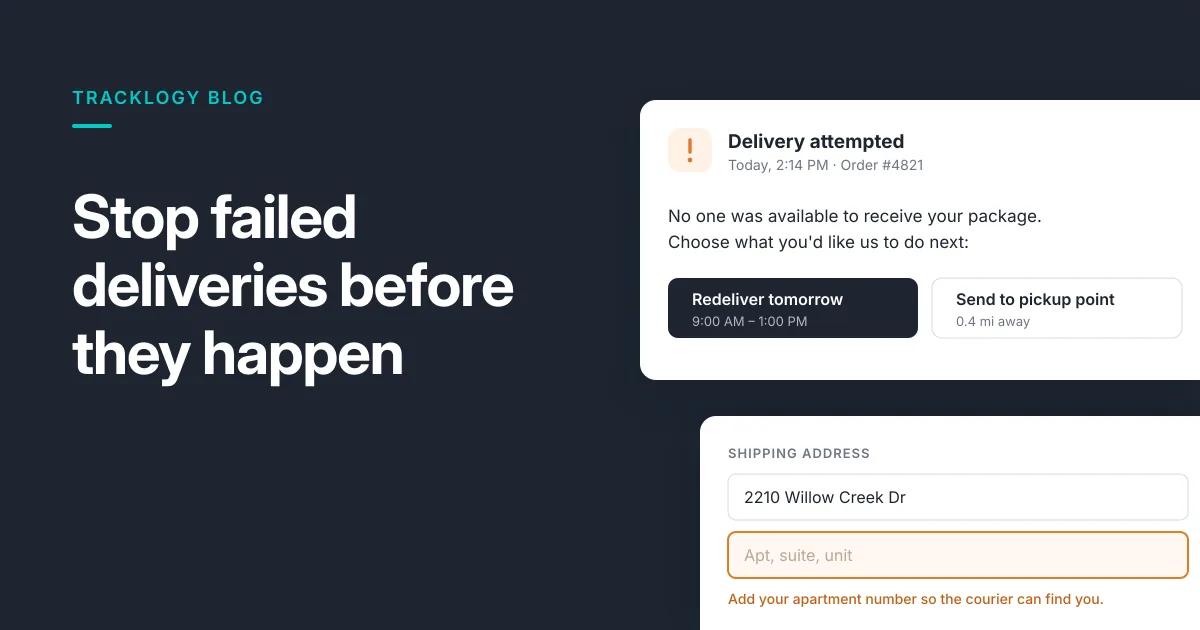
The package made it across the country, through sorting centres, and onto the delivery van. Then, at the very last step, it didn't get delivered.
A failed delivery attempt is one of the most frustrating moments in eCommerce — for the customer, for the carrier, and for you. It delays the order, often adds cost, and can end with the parcel being returned to your warehouse.
The good news: most failed deliveries are predictable, and many are preventable. Here's how.
A failed delivery attempt happens when a carrier tries to deliver a parcel but can't complete the handover. Tracking usually shows something like "Delivery attempted", "Recipient not available", or "Address issue".
After a failed attempt, carriers typically do one of the following, depending on the carrier and service:
Each outcome adds time, and some add direct cost. If you want to decode these statuses in more detail, see our [shipment tracking events guide](/blog/shipment-tracking-events-status-guide/).
Missing apartment numbers, typos in postcodes, and wrong street names are among the most common causes. A courier can't deliver to an address they can't find.
Signature-required parcels, cash-on-delivery orders, and deliveries to offices outside working hours often fail because nobody is there to receive them.
Many couriers call ahead or when they can't find the address. Without a working number, a small problem becomes a failed attempt.
Gated communities, locked buildings, missing door codes, and strict reception rules can stop a delivery at the entrance.
If the customer doesn't know the delivery day, they can't plan to be home. This is a communication problem, not a logistics one.
In COD-heavy markets, customers sometimes refuse or aren't ready to pay at the door, which leads to a return to origin.
Use address autocomplete and validation so customers choose a real, complete address. Make the apartment/unit field visible, and make a phone number required.
An "out for delivery today" message is one of the most effective tools you have. It gives the customer a chance to be home, arrange a neighbour, or leave instructions. We include a ready-to-use version in our [shipping email templates](/blog/shipping-confirmation-email-templates/).
Add an optional "delivery instructions" field at checkout — gate codes, safe places, reception details — and pass it to the carrier on the label.
Where your carriers support it, give customers the option to ship to a pickup point or parcel locker. It removes the "nobody home" problem entirely.
The first failed attempt is your warning sign. Message the customer immediately with:
Fast, clear communication often turns a failed attempt into a successful second attempt instead of a return. See our guide on [handling shipment exceptions without losing customer trust](/blog/handle-shipment-exceptions-customer-trust/).
For COD orders or very high-value orders, a quick confirmation (SMS, WhatsApp, or email) before dispatch reduces refusals and wrong-address shipments.
Monitor failed delivery attempts as a percentage of shipments, by carrier and by region. Patterns will show where to act — a carrier that struggles in one area, or a checkout field customers keep getting wrong. Our list of [shipment tracking metrics](/blog/shipment-tracking-metrics-ecommerce/) shows what else to watch.
| Stage | Action |
|---|---|
| Checkout | Validate address, require phone, collect instructions |
| Before dispatch | Confirm COD / high-value orders |
| In transit | Send shipped and estimated-delivery updates |
| Delivery day | Send "out for delivery" notification |
| First failed attempt | Notify customer immediately with next steps |
| Final attempt / return | Contact customer, offer reshipment or refund |
| Monthly | Review failed delivery rate by carrier and region |
TrackLogy monitors carrier events across 1,000+ carriers and flags delivery exceptions — including failed attempts — the moment they appear. You can automatically notify customers with clear next steps, send out-for-delivery alerts, and see every exception in one dashboard instead of checking carrier sites one by one.
If you sell internationally, also read our guide to [international shipment tracking](/blog/international-shipment-tracking-cross-border/), where handoffs between carriers make failed deliveries more likely.
It means the carrier tried to deliver the parcel but couldn't complete the delivery — usually because nobody was available, the address couldn't be found, or access was blocked.
It depends on the carrier and the service. Many carriers make one to three attempts or move the parcel to a pickup point after the first attempt. Check your carrier's policy for exact rules.
The parcel is usually re-attempted, held at a depot or pickup point for collection, or returned to the sender after the final attempt.
Validate addresses at checkout, require a phone number, send out-for-delivery notifications, offer pickup points, and contact the customer immediately after the first failed attempt.
Catch failed deliveries before they become returns. [Start your free TrackLogy trial](https://my.tracklogy.com/register).
Emily Hargrove·5 min read
Sarah Mitchell·6 min read
Sarah Mitchell·5 min read
Ready to Upgrade Your Post-Purchase Experience?
Start your free trial. No credit card required.
Start Free Trial